Master Plan
Nambiar Kanakapura Road Masterplan
The Nambiar Kanakapura Road master plan is what makes a 120-acre township meaningfully different from a cluster of apartment towers. A site this large gives the design team room to do things that constrained plots cannot: spread buildings far apart, hold large contiguous green spaces, route a proper internal road hierarchy, and place a genuine mixed-use precinct within walking distance of homes. Detailed master plan drawings are released to registered buyers; the framework here reflects the planning approach Nambiar Builders applies to its township-scale work. Nambiar Kannamangala is useful for the site-planning lens because buyers should read open space, movement, parking, and amenity placement as everyday-use details, not brochure decoration.
120
Acres
~45-55%
Open Space Share
Central
Green Spine
Phased
Delivery
Site Layout
The 120-Acre Site Layout
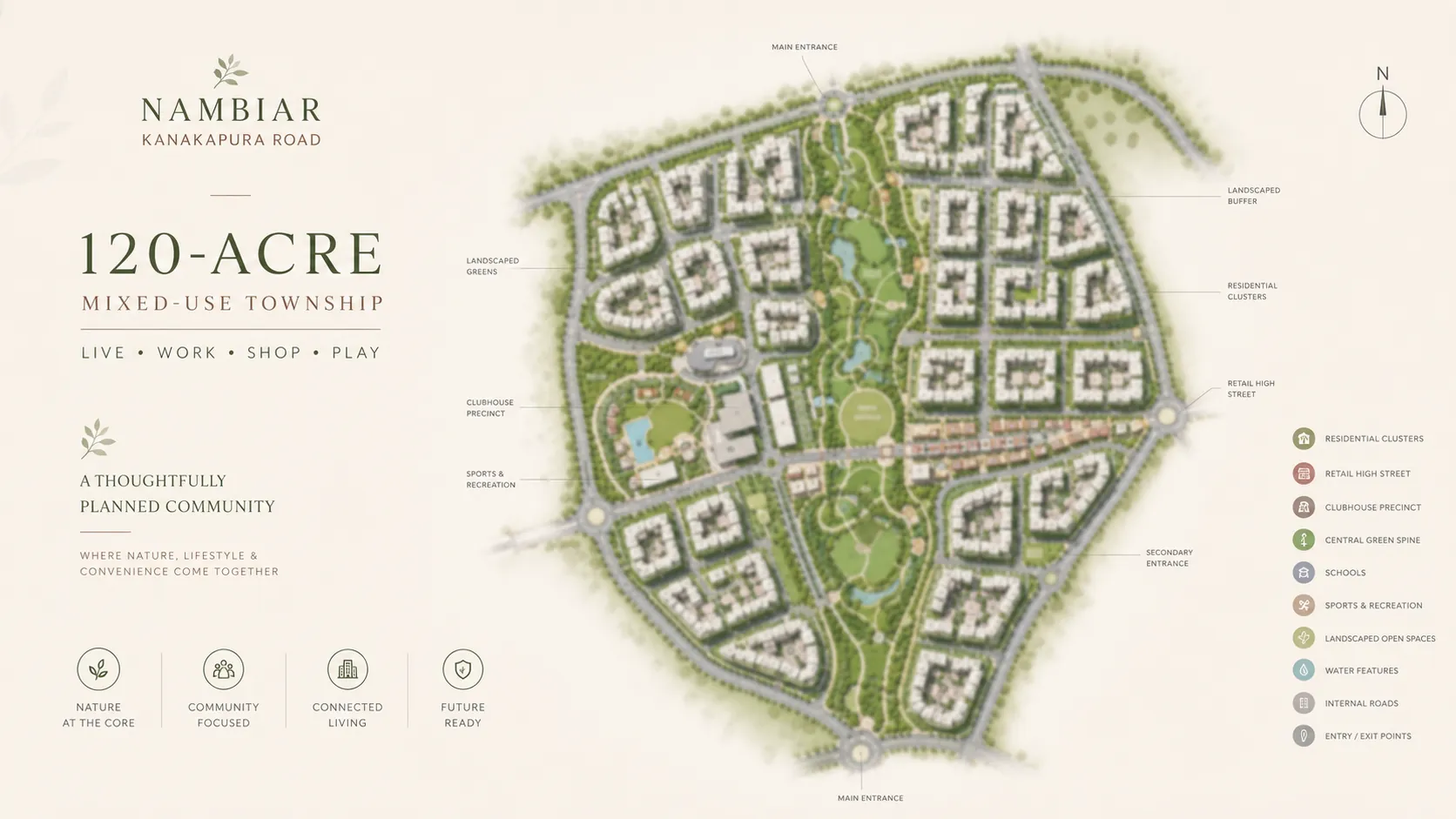
Rather than lining buildings along the boundary, the plan groups residences into clusters around shared landscaped courts and the central green spine. Clusters are oriented to optimise daylight and cross-ventilation and to frame views toward open space rather than toward neighbouring buildings. Generous setbacks between towers reduce overlooking and preserve privacy. Phasing is built into the cluster logic: early phases are completed and occupied - with first-phase possession indicated from April 2027 - while later clusters are constructed, so construction activity is buffered away from occupied homes.
Land Use
Land Use Framework
A 120-acre township is planned around a deliberate balance between built form and open space. Nambiar Builders' township philosophy favours low ground coverage and high open-space share, so a large proportion of the site reads as landscape rather than building.
| Land use | Indicative share | Purpose |
|---|---|---|
| Residential clusters (built footprint) | ~25–30% | Towers / blocks arranged in clusters |
| Open, landscaped & recreational | ~45–55% | Central green, gardens, sports, play |
| Roads, circulation & parking access | ~12–15% | Internal road network and entries |
| Mixed-use precinct (retail / F&B / social) | ~5–8% | Walk-to high street and amenities |
| Utilities & services | ~3–5% | STP, water, electrical, waste, solar |
The headline figure is the open-space share. By keeping the built footprint low and concentrating density into well-spaced clusters, the plan preserves light, ventilation and views for a far larger share of homes than a dense site could - and gives the township its landscape-led character.
Open Space
Green Spine & Open-Space Design
The defining feature of the master plan is a central green spine that threads through the township and connects the residential clusters to the amenity precinct. Off this spine sit themed gardens, lawns, water features and quiet pockets for seniors and reflection. Existing tree cover is retained wherever the plan allows, and new avenue planting lines the internal roads. The open-space network is designed to be continuous and walkable, so a resident can move from home to clubhouse to retail almost entirely through landscape rather than along traffic. Shaded pedestrian paths link the residential clusters to the clubhouse, sports zones, children's areas and the mixed-use high street, with seating nodes, play points and exercise stations distributed along the walking loops.
Circulation
Road & Circulation Network
The internal road network follows a clear hierarchy: a primary loop connects the gated entries to each cluster, secondary roads serve individual clusters, and a continuous pedestrian and cycling network runs parallel but separated from vehicles. Entry and exit are controlled through gated checkpoints with boom barriers and visitor management. Parking is handled at podium, basement or at-grade level depending on cluster type, keeping surface areas free for landscape and pedestrians. The aim is a campus where children, walkers and cyclists can move safely without constant interaction with cars.
Mixed-Use Precinct
The Mixed-Use Precinct
What sets this master plan apart is the dedicated mixed-use precinct. Positioned for easy walk-up access from the residential clusters, it is planned to hold a retail high street, a food and beverage cluster, a convenience supermarket, and provisions for a school or pre-school and a clinic or healthcare touchpoint. Locating these uses inside the township - rather than relying on Kanakapura Road's external retail - is what turns the development from a residential complex into a self-sufficient neighbourhood, and it concentrates daily footfall in a single, walkable hub.
Infrastructure
Service & Sustainability Infrastructure
A township runs on infrastructure that residents rarely see. The master plan integrates a sewage treatment plant (STP) sized for the full community, with dual plumbing so treated water is reused for flushing and landscape irrigation; underground and overhead water storage with a managed supply network; graded stormwater drainage feeding rainwater harvesting and recharge pits; dedicated substation provisions with 100% DG backup for common services and lifts; and segregation points with an organic waste converter to process wet waste on site. Sustainability is embedded rather than treated as an add-on - rainwater harvesting recharges groundwater, solar photovoltaics power common-area lighting, EV-charging provisions are designed into parking from the outset, and the low ground-coverage, high-green-share layout itself moderates microclimate, manages stormwater and supports biodiversity.
Why It Matters
Density & Open-Space Comparison
The clearest way to appreciate the master plan is to compare it with the corridor's smaller projects. A four-to-forty-acre development must concentrate its buildings, which limits setbacks, fragments open space and constrains amenities to what fits between blocks. A 120-acre site removes those constraints: buildings can sit far apart, open space can be contiguous and large enough to be genuinely usable, and the road and pedestrian networks can be properly separated. The result is a living environment that reads as a green campus rather than a built-up colony - more light and air at home, safer internal streets, and recreation space measured in acres rather than square feet. For a buyer, a plan with low ground coverage, a continuous green spine, separated pedestrian movement and a walk-to mixed-use hub also protects value: well-planned townships hold and grow value better than ad-hoc developments because the experience they offer is hard to replicate.
Phasing & Resilience
Phasing strategy and environmental resilience
A 120-acre township is necessarily delivered in phases, and the phasing logic at Nambiar Kanakapura Road is itself a design decision. The master plan is structured so that early phases - including the first residential clusters indicated for possession from April 2027 - are completed, occupied and amenitised while later clusters are still under construction. Construction activity is buffered away from occupied homes, and a meaningful share of the core amenities is delivered early so that the first residents are not waiting years for the clubhouse, pool or green spine to open. As later phases complete, satellite clubhouses and additional amenities extend the offering across the community. For a buyer, understanding which phase a unit sits in - and which amenities are delivered in that phase versus later - is an important part of the decision, and is confirmed in the phase-specific RERA documentation.
A 120-acre master plan can also manage water and environmental load at a scale that smaller sites cannot. The graded site design channels stormwater toward rainwater-harvesting pits and recharge structures rather than letting it run off, helping replenish groundwater and reduce flooding risk during Bengaluru's intense monsoon spells. The sewage treatment plant and dual-plumbing network close the water loop by recycling treated water for flushing and irrigation, cutting fresh-water demand. Retained tree cover and the continuous green spine moderate microclimate, lowering ambient temperatures and improving air quality across the community. Together these systems make Nambiar Kanakapura Road more self-reliant on water and more resilient to the climate stresses that increasingly affect the city.
Buyer Questions
Nambiar Kanakapura Road Master Plan - FAQ
How big is the Nambiar Kanakapura Road master plan?
The township spans 120 acres - among the largest single master plans on Kanakapura Road, roughly three times the footprint of Prestige Falcon City. The land area lets the design team spread buildings far apart, hold large contiguous green spaces, route a proper internal road hierarchy and place a genuine mixed-use precinct within walking distance of homes.
How is the land used across the township?
The plan favours low ground coverage and high open-space share: roughly 25-30% built footprint, 45-55% open, landscaped and recreational area, 12-15% roads and circulation, 5-8% mixed-use precinct and 3-5% utilities and services. The headline figure is the open-space share, which preserves light, ventilation and views for a far larger share of homes than a dense site could.
What is the central green spine?
The defining feature of the master plan is a central green spine that threads through the township and connects the residential clusters to the amenity precinct. Off this spine sit themed gardens, lawns, water features and quiet pockets, with a continuous, walkable open-space network so residents can move from home to clubhouse to retail almost entirely through landscape.
What makes it a mixed-use master plan?
The plan reserves a dedicated mixed-use precinct - a retail high street, an F&B cluster, a convenience supermarket and provisions for a school or pre-school and a clinic - positioned for easy walk-up access from the residential clusters. Locating these uses inside the township turns it from a residential complex into a self-sufficient neighbourhood.
How is the township phased?
A 120-acre township is delivered in phases. The master plan is structured so early phases - including the first residential clusters indicated for possession from April 2027 - are completed, occupied and amenitised while later clusters are built, with a meaningful share of core amenities delivered early. Confirm which phase a unit sits in, and which amenities it delivers, in the phase-specific documentation.
What sustainability infrastructure is built into the plan?
The plan embeds rainwater harvesting, solar photovoltaics for common-area lighting, an organic waste converter, EV-charging provisions and an STP with dual plumbing for treated-water reuse. The low ground-coverage, high-green-share layout itself moderates microclimate, manages stormwater and supports biodiversity.